Support Systems for Children and Families, especially those with Special Needs.

Why ReStacking Crayons?
My name is Rev. J. Todd Bruning.
I am a Pastor who has specialized in Children, Youth & Family ministry for almost 35 years. But nothing helped prepare me better for ministry than my journey with Al-Anon through the Twelve Steps of recovery.
The faith I grew up with in the Lutheran church did not equip me to deal with the challenges I faced in young adulthood. Divorce. A broken family. Loved ones abusing alcohol and drugs. Post-traumatic stress. Depression. Anxiety. Financial woes. Health challenges. Autism. Speech delays.
I grew up in a church that preached Grace. Forgiveness. Renewal. Recovery.
But I could find no path in our teachings that led to the kind of Recovery for which my heart was yearning. Something in my soul was broken. Something in my childhood had wounded me. And it wasn’t a part of my cognitive memories. But something tugged and gnawed at my conscious awareness. I wasn’t as well as I could be. But I needed to be very cautious about who I trusted with my haunting questions.
Somebody could be destroyed if I told the truth to the wrong person. Yet I had no idea who that “somebody” or “wrong person” might be. Me? Another child? A trusted adult?
I had learned to hide my deepest and darkest struggles from others. Especially people in the church. Nobody else seemed to be using language in the church that helped me feel like my struggles were normal, were understood, were expected, were worthy of God’s attention, my attention, and the attention of the leaders of my church.
I learned that others were silent about their own secret struggles too. I sensed that I was by no means alone. That hundreds, even thousands of others shared my pain. But hardly anyone was willing to talk about it plainly, openly, truthfully.
We weren’t normal. Something about us was different.
We were children with Special Needs. Growing into adults. With secrets.
For me, it turned out to be what I had seen and witnessed in a child care setting very early in life. While my parents were at work, teaching high school kids and elementary age kids respectively … I was entrusted to the care of a neighbor. A neighbor who could well be trusted. Except … When …
When the landlord arrived.
Especially when he arrived pretending to collect the rent, which he said was past due. At least once a week, under this pretense, he would enter the home where I was staying. And he would ritually and maliciously abuse this woman, while we, the children there, were forced to watch.
The abuse was far more psychological than physical. He seemed to thrive on the fear he could create, could enduce. He never used the gun that he tucked into his pocket to generate a deadly explosion. But in her eyes we could sense the danger its presence exuded. We could see her expression shift alarmingly from whimpering fear to abject terror … as he made that gun click … in many … subtly … different ways.
If pointing the barrel of the gun at her would not generate the right level of terror … he would point it at us. And the pitch of her whining pleas would rise. If there were not enough horrific tears pouring down her face, he would walk closer to us, experimenting to see where he might point that gun, that would get the most desperate reaction. And he might say, “Open your mouth.” Or, “Pull down your pants.”
I don’t think he ever did anything to me. Physically. I don’t remember any physical pain that I felt with my external nerves and sensations. But I felt so much imagined pain. Empathizing with this woman. And her children. And their plight.
One thing he did do to me. Before he would leave. After he had inflicted enough horror. He would come over and look me straight in the eyes and say.
“Don’t tell anyone about this. If you tell anybody and I find out. I will kill her. And him. And her. And your parents. With this.” And then he made me look at the gun, before tucking it menacingly back into his pocket.
So little. And I still wanted to fight the intimidation I felt. I wanted to show no fear. I wanted to find a power inside of me that he could not squash. Could not quench. Could not quiet. But I also knew how easily a challenging look could re-ignite another sadistic ritual. So little. And I felt responsible for the trauma occurring in that home.
After a few months my little brother was born and we moved quite a ways away. To a new home. A larger home. A safer home.
And I never told anyone anything. For decades.
But for the rest of my life, I have searched every shadow, every hiding place. Worried that this monster, tucked away into the forgotten recesses of my subconscious, might reappear. Might return. Might renew his threat.
For the next twenty years I was unnaturally shy and silent. I was smaller than most of my peers, and that size disadvantage made me painfully aware of my vulnerability to monsters, bullies, and angry, power-hungry people in general.
For the next twenty years, as I grew up, I began to recover my voice … in many different ways. I had grown up in a hyper-vigilant anxiety. And I needed to grow and heal … to learn and unlearn important lessons … in many ways. And I became very thankful for the alcoholics in my family. For through them I found my need for and the benefit found through the Twelve Steps of recovery.
As I found my voice, found my own gifts and talents, found my leverage, discovered that I had power … too … again, though, I worried. How could I have this power, use this power, to help people … rather than harm them? And I could find no guarantee anywhere, that I would and could always use my power to help and not to harm. I was no longer shy, nor silent. Far from it.
But I had a deep distrust of anybody and everybody with power of any kind. Including myself. And I found myself deeply distressed that so many people with so much power seemed to be able to act in such careless, harmful, even abusive ways … with so little accountability. And that included me.
And just at the time when I was wondering how one might live life authentically … with both power AND accountability … with both truth and vulnerability …
My son was born.
Without a voice.
Now there is more to Autism than shyness and silence.
There is a painful and profound sensory overload that tends to come with Autism.
But one of the greatest challenges a child with Autism must face … is the sense of powerlessness over an often capricious and threatening world. More. So much more. About this. Later.
But my journey with my son has been to help him find his voice, his own voice.
And to help him find his power, his own power.
But I can’t do that without claiming my own. And welcoming the accountability that allows me to provide more help … and do less harm.
I still wish I could do that without telling my story about my earliest, almost preverbal memories. I still wish I could do that without feeling, again, the horror and shame and vulnerability that always lingers, no matter how many times I share my story. I still wish my son didn’t have to struggle with Autism.
These are wishes for a life, for a past, that did not exist. And if I give into these wishes, when I give into these wishes, the monster wins. The giant wins.
For what I miss, when I try to wish the monster away, is how much more powerful the healing forces have been in my life. Than the harmful ones. For every force that has brought pain into my life … there have been hundreds … even thousands that have brought such pleasure and peace and joy. When I wish away the pain, I also wish away a wonderful world of good … of goodness … of greatness.
Every person in my life has let me down in some way, sometime. And I have let down every person in my life as well, at some time, in some way. But that is only a fraction of the world as I know it, if I am willing to count my blessings accurately as well. For people are so much more of a blessing to me than a threat. And now, thanks to my son, even crayons are so much more of a blessing to me too.
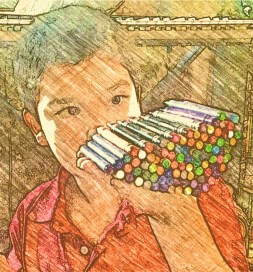
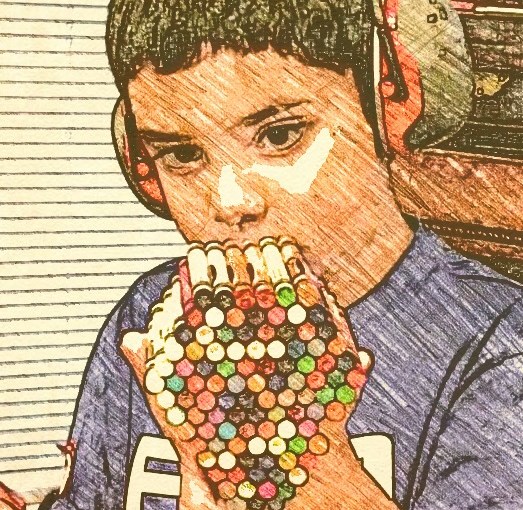
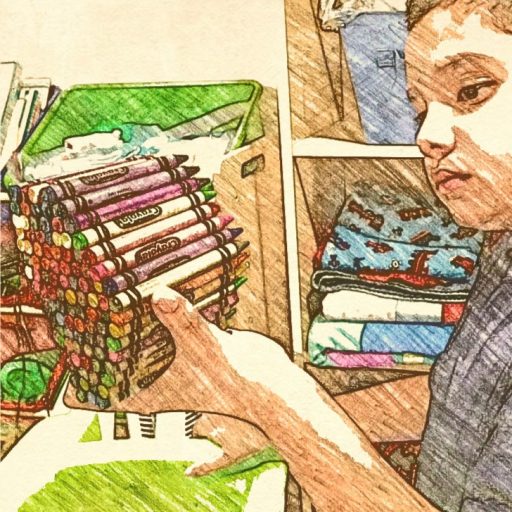
My son has a penchant for stacking crayons. And you will hear more about that, should you choose to read more of my writing.
In some way, stacking crayons helps him deal with his sensory overload, provides him comfort in moments of turmoil. But inevitably, as deliberately and pain-stakingly as he builds that stack … he destroys it as well. He builds it up. And it comes crashing down.
And again, he builds it up. And again it comes crashing down.
But he never, ever stops building. Even though the crash is inevitable.
And in the stacking. And restacking. Of the crayons.
He has become my role model.
As he trusts me. To help him. I learn to trust him. To help me. And I sense, not only his power. But my own. Growing.
As we help each other. To find our voice.
Individually.
And together.
Stacking.
And, yes, restacking.
 ReStacking Crayons